In the 5th grade, I was assigned a "family tree" project. The task was simple: start with your parent's information (name, date of birth, place of birth) and go back two more generations. I made an A+ on the assignment...and decided to keep going. I wanted to know more about my family's history. I badgered my parents and father's parents for information: names, dates, places, occupations, etc. After these sources were exhausted, my father took me to the Huntsville Public Library to continue my research in the Family History room where they stored thousands of books and census records of every state and county in the U.S. (It was the early 1990s--long before Ancestry.com was around). I spent countless Sunday afternoons there in between church services, sifting through records and books, hoping to discover the answers to all my questions about my ancestors. I learned how to take meticulous notes and created my own personal records--many of which I still have 27 years later.
A few years later, when the internet became accessible to most households, the search became easier. Printed records were scanned and entered into online databases and I searched every one available, bought family tree software programs, and continued to piece together information about my ancestors.
When Ancestry started up, I jumped on that train--finding more information than ever before. WW1 draft cards, land records, and immigration records dating back to the 17th century became accessible with the click of my mouse.
Then, there was DNA.
In 2011, National Geographic started the Genographic Project and I submitted a sample that would tell me what haplogroup I belonged to (on my mother's side--since I am female and did not inherit my father's y-chromosome).
I discovered that I belong to the U5 haplogroup--telling me a little about my direct maternal deep ancestry, but nothing specific.
Other DNA ancestry tests started popping up, so I finally decided to try another one (My Heritage DNA) in the fall of 2018. This one checked autosomal DNA on both my father's and mother's side and would give me more information about the last 5-6 generations of my family tree. As soon as I got my results, I persuaded my parents to do the test too. The results surprised me--at least in the smaller percentages of my ancestry makeup.
Results from My Heritage:



A few years later, when the internet became accessible to most households, the search became easier. Printed records were scanned and entered into online databases and I searched every one available, bought family tree software programs, and continued to piece together information about my ancestors.
When Ancestry started up, I jumped on that train--finding more information than ever before. WW1 draft cards, land records, and immigration records dating back to the 17th century became accessible with the click of my mouse.
Then, there was DNA.
In 2011, National Geographic started the Genographic Project and I submitted a sample that would tell me what haplogroup I belonged to (on my mother's side--since I am female and did not inherit my father's y-chromosome).
I discovered that I belong to the U5 haplogroup--telling me a little about my direct maternal deep ancestry, but nothing specific.
Other DNA ancestry tests started popping up, so I finally decided to try another one (My Heritage DNA) in the fall of 2018. This one checked autosomal DNA on both my father's and mother's side and would give me more information about the last 5-6 generations of my family tree. As soon as I got my results, I persuaded my parents to do the test too. The results surprised me--at least in the smaller percentages of my ancestry makeup.
Results from My Heritage:

After reading about the variabilities between tests (algorithms and all that), I uploaded my raw data DNA to several other sites to see how different the results would be.
The first one I used was Family Tree DNA (FTDNA) after paying $19 for an ethnicity estimate based on their 24 reference populations from around the world (a small number compared to other sites).
Here are my results:

These results seem very different from the My Heritage results, but when you consider that FTDNA has half of the reference populations that My Heritage does, it starts to make more sense.
X Code Life was the next site I uploaded my raw data to, after paying a $40 fee for a ten-page report on my ethnicity breakdown. Not only does this company give you an ethnicity estimate on a broad level, it also breaks down any ethnicity over 5% into sub-ethnicities (like African tribes, European countries, etc.).
Here were my results from X Code Life (the Global results should be viewed first):

Next came DNA Land--a site that lets you upload your raw data for FREE. (Of course, the results are much less detailed than some of the others). I've included my results alongside my parents' results to compare.
 |
| (Because of bright colors, click on photo to see hard-to-read sections.) |
GedMatch was the final site I uploaded our raw data into (also FREE). Since there are so many options on this site, I've only included the Eurogenes K13 results for mine and my parent's ethnicity breakdown.


The final test I decided to use was Ancestry's DNA test. They do not allow any uploads of raw data from previous tests, so I had to send them a fresh (spit) sample. My sample has been received by them at their Utah lab, but results won't be ready for 6-8 weeks, so I'll update this blog as soon as those are ready. I'm curious to see how they are similar/different to the others since they have more reference populations that the other tests I've done. They are reported to be "the best," but I've also heard that about My Heritage and 23 and Me (whose test I haven't done yet).
Until then!
UPDATE:
Ancestry DNA results arrived tonight...
While these results seem very different from my other results at first glance, when I click on the regions, there is a lot of overlap that makes the estimates make more sense. For instance, the highest percentage (England, Wales, and NW Europe) includes Scotland and the edge of Ireland--even though my "Ireland and Scotland" percentage is only shown as 25% on this test--as opposed to the 54.7% on the MyHeritage test (which also included Wales).
The biggest difference I'm seeing is the absence of Western Asian (from the MyHeritage test and a couple of the others)--making me wonder if the reference populations for these regions (through Ancestry's test) were fewer than those from the other tests (MyHeritage, XCode Life, DNA Land, GedMatch).
This is a good example of how these DNA tests vary when it comes to ethnicity estimates.

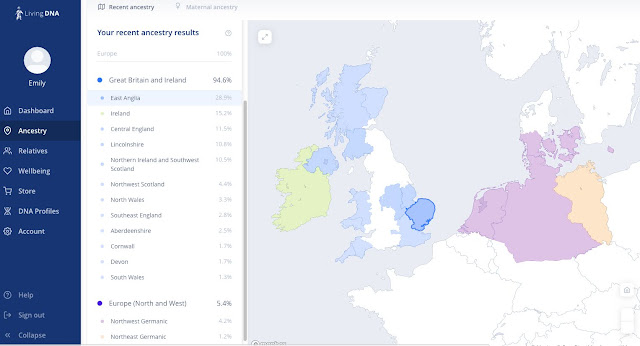
UPDATE April 2, 2020: It took ages to get results from Living DNA after uploading my raw DNA data, but they're finally in!
Also got an ancient admixture test from Genomelink. Results took about 30 minutes after uploading raw data DNA file.


